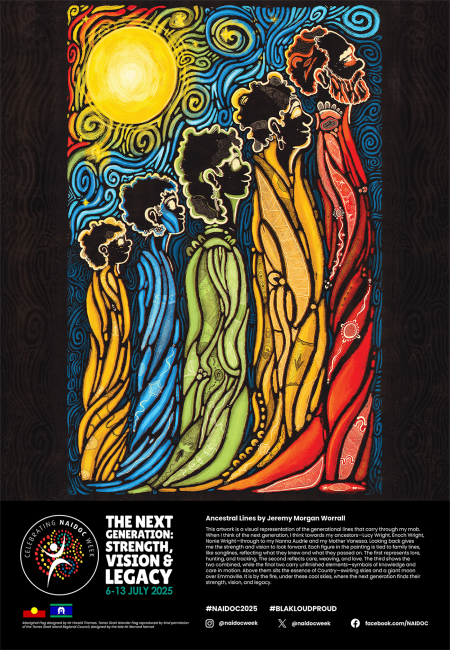
Image Copyright: image obtained from the NAIDOC website (https://www.naidoc.org.au/posters/poster-gallery/2025-national-naidoc-week-poster)
NAIDOC Week – July 6-13, 2025 “The Next Generation; Strength, Vision and Legacy.”
Sunday – July 6 “Sent Forth in Strength and Hope”
The theme of this year’s NAIDOC week is, “The Next Generation: Strength, Vision and Legacy”. These words suggest a pathway forward for the next generation of Aboriginal and Torres Strait Islander peoples. Clearly their ancestors have left a culture built on a closeness to the land and a strong bond of kinship relationships with family, community and clan, as well as a deep underlying spirituality. As we know, all these life enriching qualities have been developed over many thousands of years and have sustained the First Nations peoples over all that time. Thus, this legacy gives strength to the First Nation peoples of today to build a vision for their future in ever changing circumstances.
Pope St. John Paul II spoke of the value of the Aboriginal and Torres Strait Islander culture when he addressed them at Alice Springs on the 29th of November, 1986. He said:-
“Your culture, which shows the lasting genius and dignity of your race, must not be allowed to disappear. Do not think that your gifts are worth so little that you should no longer bother to maintain them.”
With this resounding endorsement, the Pope affirmed the values and the precious nature of this enduring culture. In the terms of a Gospel parable, we may call First Nations culture a ‘pearl of great price’ - Once being almost lost but now being found.
Furthermore, Pope John Paul II continues: “ Share them (these gifts) with each other and teach them to your children. Your songs, your stories, your paintings, your dances, your languages, must never be lost.”
NAIDOC week is a time for First Nations people to celebrate and share their cultural assets which are also called a gift by the Pope. While the Indigenous people share this gift with their children, they also offer the same to the whole of Australian society. NAIDOC week thus provides all Austalians with the opportunity to become ‘fully ‘what we are meant to be – one together in diversity.
At the beginning of NAIDOC week, we in the Catholic Church, also celebrate National Aboriginal and Torres Strait Islander Sunday, July 6. It is an occasion for us to reflect on how, we as Catholics, can be a part of the special journey of the First Nations Peoples.
In a general audience ( Paul VI Hall, 13th of October, 2021) the late Pope Francis teased out the real meaning of the word ‘catholic’ as used in the name “the Catholic Church”. Catholic, he said, “is not just a word we use to distinguish us from other Christians,” rather, ‘catholic’ he explains, means ‘universal’. Here universal as used of the Church means that, “The Church contains within herself, in her very nature, an openness to all peoples and cultures of all times, because Christ was born, died, and rose for everyone,” He continued, “so being universal means that the Catholic Church does not impose itself on all cultures but contains within itself the call to embrace all cultures.” Thus, the community of the Church’s calling is to hold all cultures with respect: to nourish and foster all those elements in a culture which manifests the values of the Gospel. Here, I am reminded of how First Nations people welcome us to their country so we, by embracing them and their culture in this way, make them welcome in the community of the Church. Therefore, as Catholics we are called to create the space for Indigenous Catholic communities to find their rightful place in the Catholic Church. In this way, the church community itself shows an openness to being transformed by this encounter. For the First Nations culture may well bring into relief certain Gospel values that we may have lost. So, in effect, this encounter is an occasion for us to grow together in faith.
As we make this journey together, we are also aware of how far we have to go. On the 30th anniversary of Pope St John Paul II’s address to the First Nations people in Alice Springs, Bishop Eugene Hurley, the former Bishop of Darwin wrote on the theme of that occasion, “Rebirth and hope”,
“This timely theme is an invitation and call to us (the Church and society) to create and ensure a change in societal attitude and promote not only rebirth and hope but justice and equal rights of Indigenous peoples.”
With suicide among First Nations peoples still high, incarceration far too prevalent, health care still not adequate in many ‘communities’, to give just a few examples, it is clear, that what Bishop Hurley wrote nine years ago about a lack of justice and equal rights for Indigenous peoples is still as relevant today. Solutions to this tragic situation seem very elusive. It is evident that trust between Frist Nations people and other Australians is often understandably low considering the history of the past two hundred years. However, the focus of this NAIDOC week does give hope. This hope is based on a confidence built on the security felt in one’s culture. This healed confidence brings an openness to encounter others. As reflected on above, NAIDOC week invites all Australians to join together on this journey to healing, reconciliation and harmony. In this spirit of openness and willingness to encounter each other as equals and fellow travellers, we pray that we will be able to grow in the trust that makes this journey together possible and fruitful for all.
Finally, St. Paul encourages us when he wrote (Rom 5,11) that in the process of coming to reconciliation with God, human beings experience a deepening trust in God. In the same, way, humans grow in trust as they travel together in honesty and sincerity. As we travel the road towards reconciliation, we pray, that all of us Australians together will experience the growth in trust in each other that will make our lives more integrated and whole. Only then, can we be the best version of ourselves as a people and as a nation. In this journey our Church communities and our society will give fuller praise to God.
Columban Fr Kelvin Barrett lives and works at St Columban’s, Essendon.